// by MaximVL for geobrowser.io
Open-Source · Geospatial Intelligence · Middle East

OSINT Globe
v3
— Live Infrastructure Intelligence

Critical infrastructure, energy systems, active fires, live aircraft, and GPS interference signals — rendered in 2D, 3D, and globe projection, live, from open data.

16Data layers
5,415OGIM energy objects
3Live signals
GlobeMapLibre 5 projection
scroll

Three projections, one platform

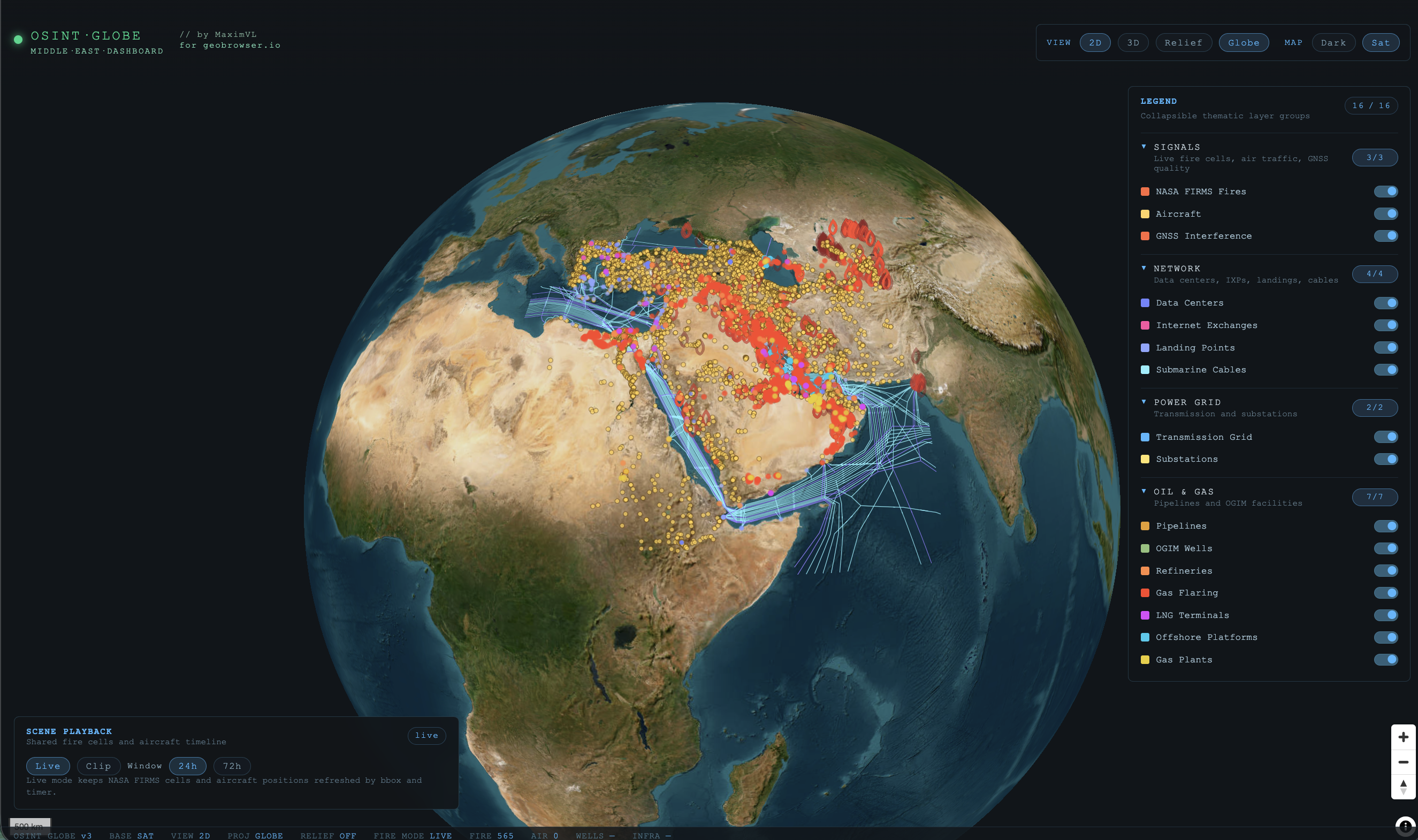
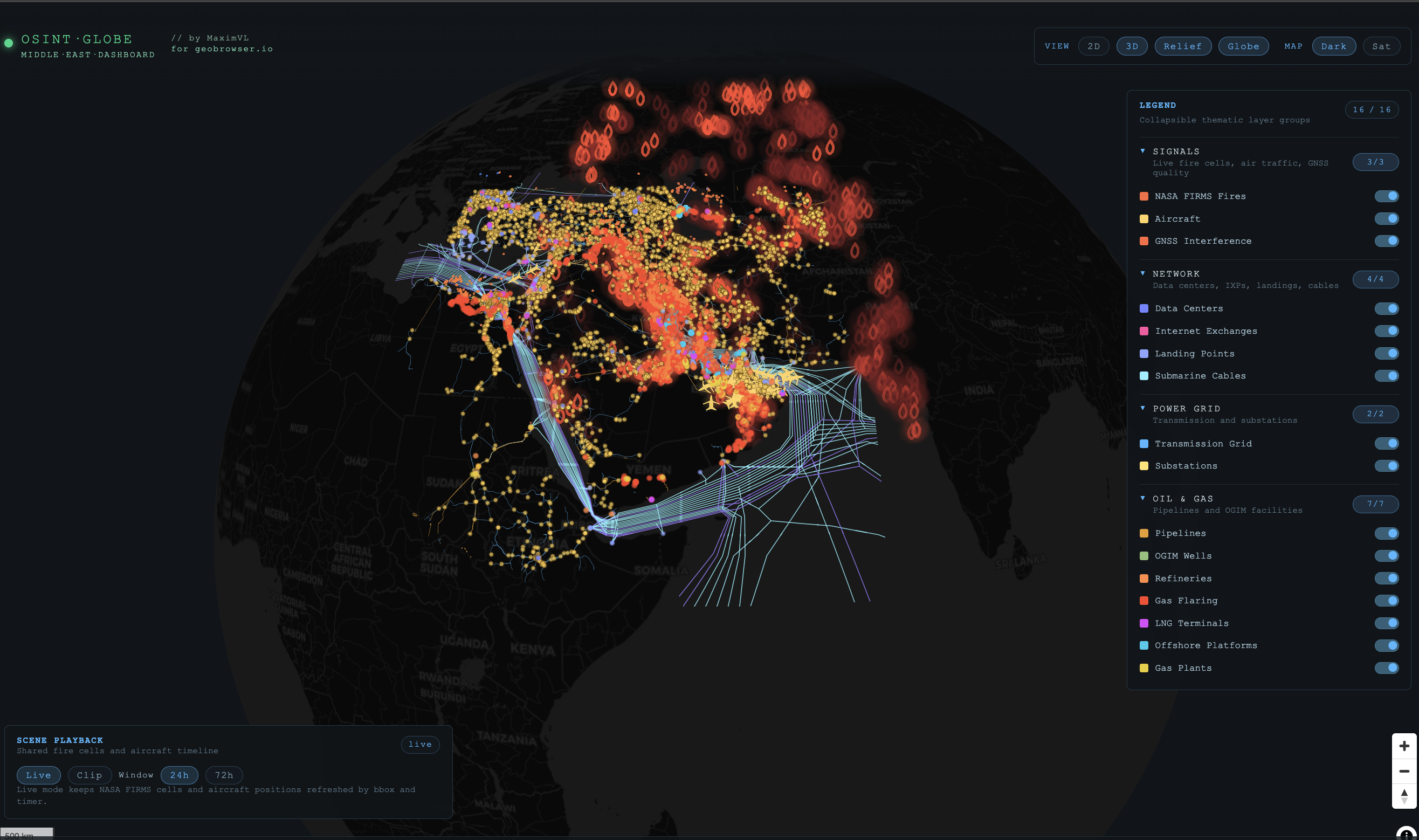
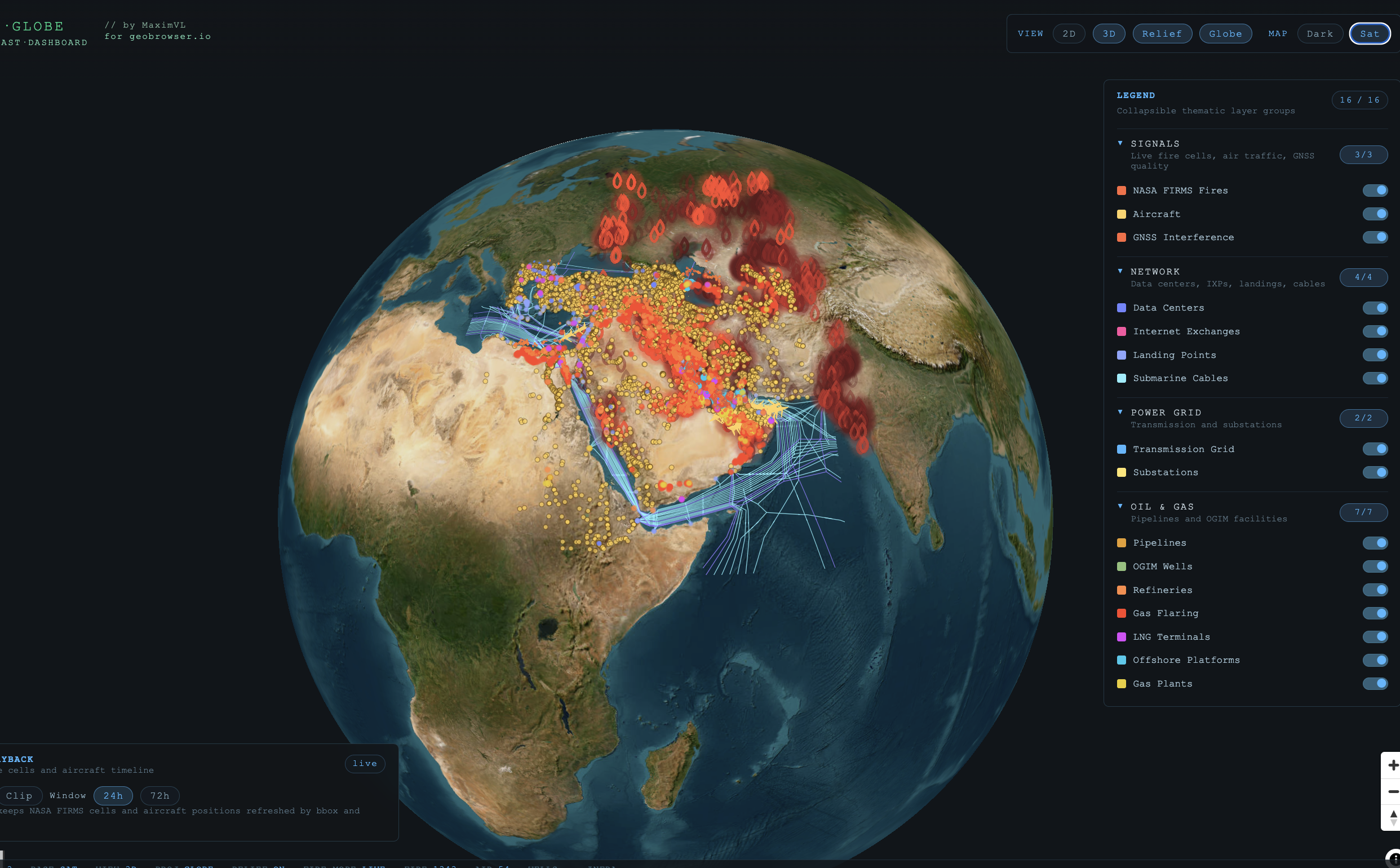
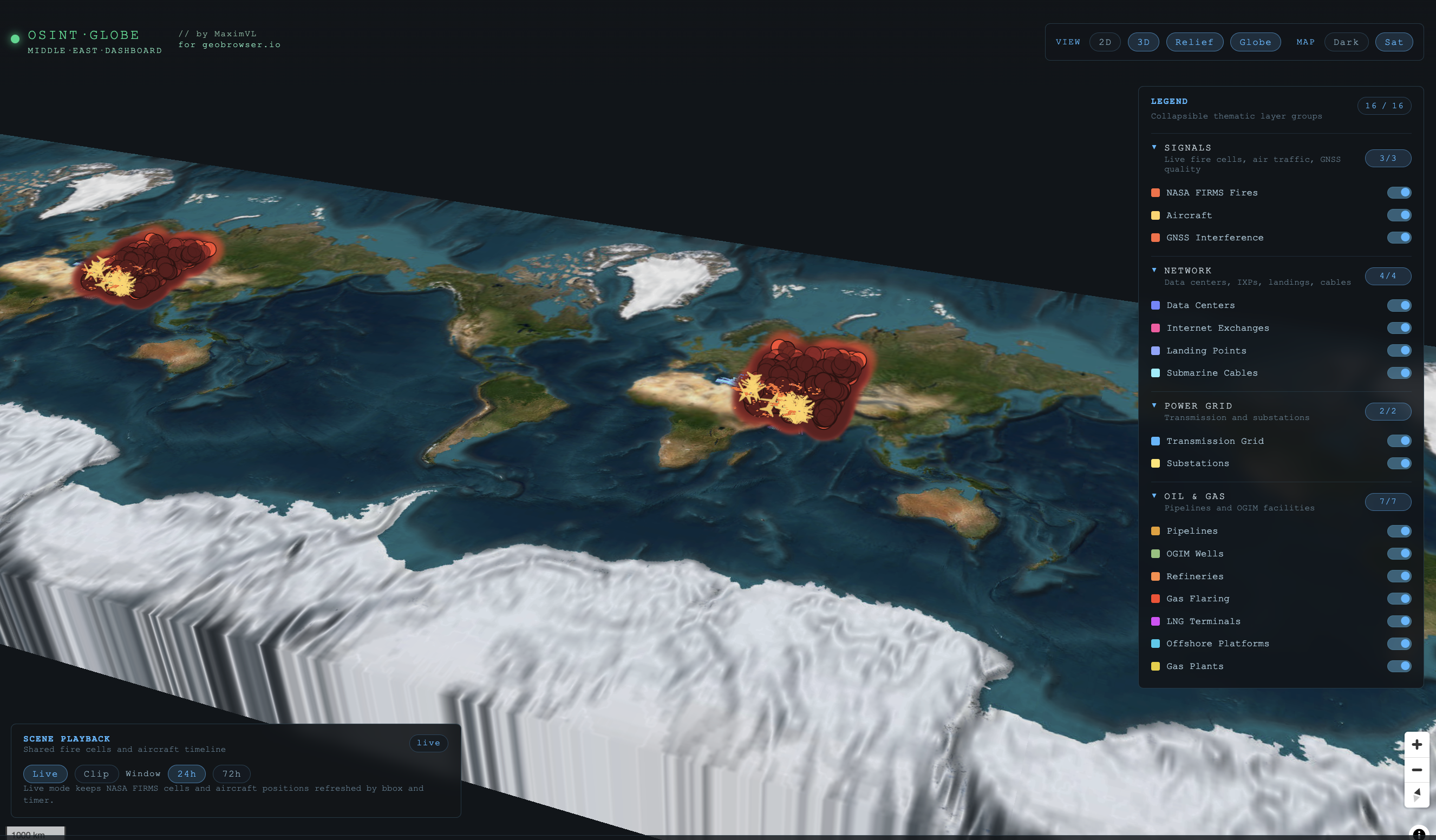
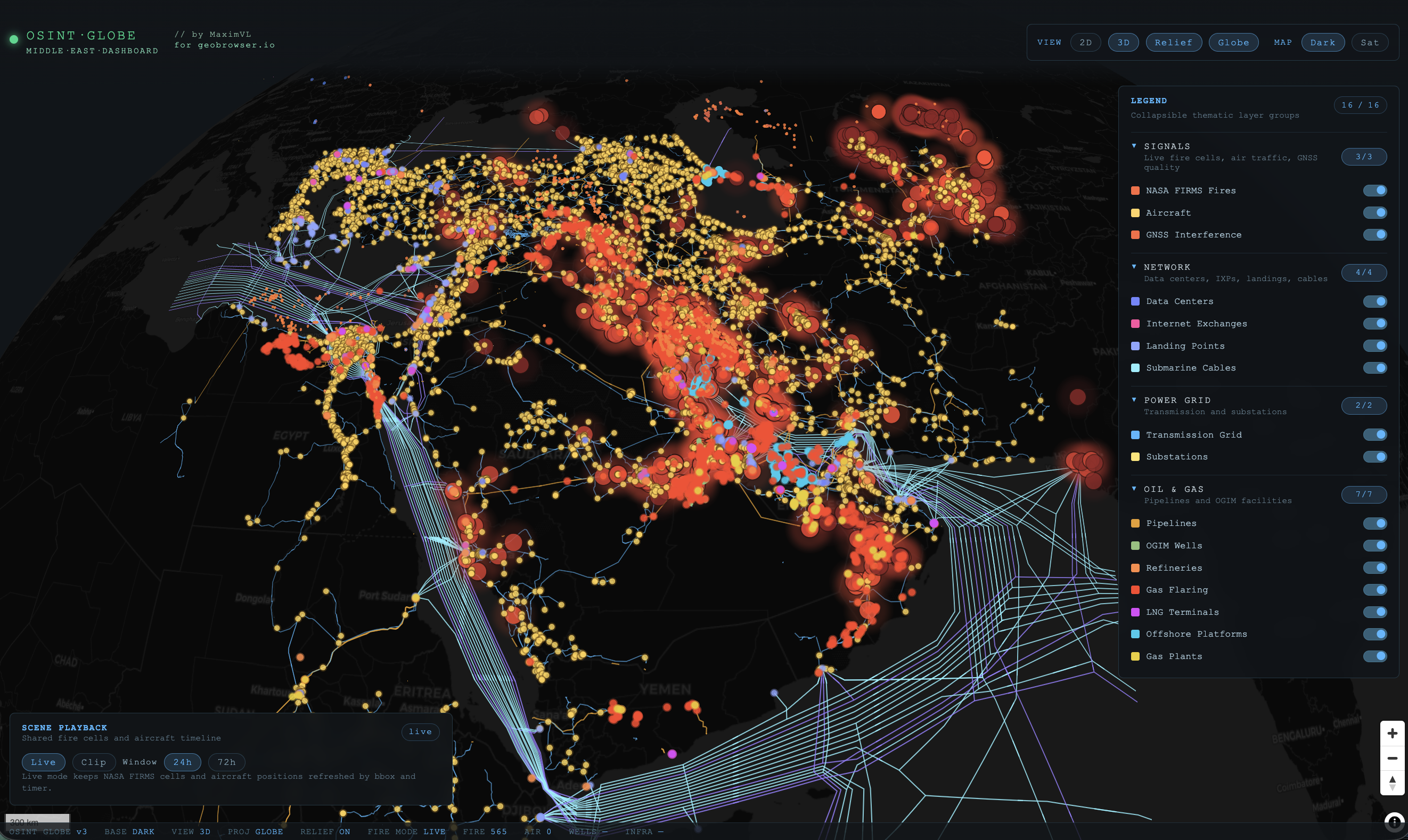
The same data — fires, infrastructure, aircraft, GNSS — rendered across 2D flat map, tilted 3D mode, and full globe projection. Basemap switches between dark, OSM, and satellite.
Infrastructure intelligence, on a live globe

Most mapping tools show borders and roads. OSINT Globe v3 shows the infrastructure beneath them: power transmission lines, oil & gas pipelines, submarine cables, data centers, internet exchange points — all overlaid on a single WebGL-rendered map, updated live.

Three live event layers run continuously: active fires from NASA FIRMS refreshed every 15 minutes, live aircraft from open ADS-B feeds updated every 5 seconds, and GNSS interference detected from ADS-B signal quality across the region.

The map runs in three projection modes — flat 2D, tilted 3D with terrain relief, and full globe projection via MapLibre GL JS 5. All 16 layers work across all three modes with independent toggles.

Sixteen layers, all on the same globe

Each layer has an independent toggle. Infrastructure layers are served from PMTiles or static GeoJSON. Live layers poll the backend API and update in place without reloading the page.

Pipelines
OpenInfraMap · global
PMTiles
🔌
Transmission Grid
OpenInfraMap · HV lines
PMTiles
🏭
Substations
OpenInfraMap · 3D height
GeoJSON
🌐
Submarine Cables
TeleGeography
GeoJSON
🖥️
Data Centers
DC-map · 3D extrusion
GeoJSON
🔗
Internet Exchanges
PeeringDB · 3D
GeoJSON
Landing Points
TeleGeography
GeoJSON
🛢️
Oil & Gas Wells
USGS OGIM · 2,724 pts
PostGIS
🏗️
Refineries
USGS OGIM · 3D
PostGIS
🛳️
Offshore Platforms
USGS OGIM · 3D
PostGIS
🏭
LNG Terminals
USGS OGIM · 3D
PostGIS
⚙️
Processing Facilities
USGS OGIM · 3D
PostGIS
🔥
Active Fires
NASA FIRMS · VIIRS NRT
Live · 15 min
✈️
Aircraft
ADS-B · live tracks
Live · 5 sec
📡
GNSS Interference
Signal quality · hex grid
Live · 15 min
🛥️
Vessel Activity
GFW maritime events
API

Three live feeds, always on

The platform runs three continuous event streams in the background. Each has its own sync loop, backend storage, and API endpoint — they don't share state and can fail independently without affecting the rest of the map.

🔥
Active Fires
NASA FIRMS satellite detections aggregated into 0.1° grid cells with a lifecycle state machine: fresh → active → stale → burn scar. Temporal playback available via clip API — scrub through any time window.
↻ every 15 minutes
✈️
Aircraft
Live ADS-B position tracks displayed as animated icons with heading. Military and civil traffic. Ground positions filtered by default. Clip playback mode lets you replay any historical window with frame-by-frame scrubbing.
↻ every 5 seconds
📡
GNSS Interference
GPS spoofing and jamming detected from degraded ADS-B signal quality across the theater. Rendered as H3 hexagonal grid — darker cells indicate higher proportion of aircraft reporting poor navigation accuracy.
↻ every 15 minutes
All three feeds are live on the same map simultaneously. You can see where aircraft are flying relative to active fire zones and GPS interference areas — in real time.

2D · 3D · Globe

The map supports three distinct projection modes, switchable with a single button. All 16 layers, all live feeds, and all interactive features work across all three modes without reloading.

Flat
2D Mercator
Standard top-down view. Best for dense layer inspection and precise geographic comparison. Default mode on load.
Tilted
3D Terrain
Pitch and bearing applied. Infrastructure objects extruded to real-world heights. Mapzen DEM terrain relief. deck.gl shares WebGL depth buffer with MapLibre.
Spherical
Globe
Full globe projection via MapLibre GL JS 5. Atmospheric haze, space background. Satellite basemap shows the planet as seen from orbit. Natural scale at theater level.

At Middle East theater scale — from Turkey to Yemen, from Egypt to Iran — the globe projection gives natural scale that flat Mercator distorts. Submarine cable routes, pipeline corridors, and aircraft tracks all read more accurately on a sphere.

NASA FIRMS, every 15 minutes

The fire pipeline ingests from NASA FIRMS (VIIRS SNPP Near Real-Time) and stores detections in PostgreSQL with a lifecycle state machine. A multi-day backfill runs on first start to populate historical context.

🛰️ NASA FIRMS VIIRS SNPP NRT
⚙️ Ingest 15 min cadence
🗄️ PostGIS events + fire_cells
🔥 API /api/fire/live
🌍 Globe live render

Individual detections are aggregated into fire cells — 0.1° × 0.1° grid cells that track lifecycle state:

fresh active stale recent_burn burn_scar hidden

The API exposes a configurable decay window — how many hours back to show fires — and a temporal clip endpoint that returns bucketed frames for scrubbing through a time range. Fire radius scales with zoom level in globe mode and with observation count in 2D/3D mode.

5,415 energy objects from USGS OGIM

The USGS Global Oil and Gas Infrastructure Mapper dataset is loaded into PostGIS across five tables. Each category has its own 3D color, height formula, and bounding-box API endpoint. All queried live from the map viewport.

Type Color 3D height source
Oil & Gas Wells (2,724)● Cyanpoint marker
Refineries● Orange-redliquid capacity (BPD)
Offshore Platforms● Bluelog-normalized score
LNG Terminals● Purplegas capacity (MMCFD)
Processing Facilities● Greenbase height

In 3D mode, object heights reflect real-world significance: a refinery with higher throughput stands taller than a smaller one in the same city. Log scale prevents dominant facilities from making everything else invisible.

Cross-layer intelligence, in one view

The combination of static infrastructure and live event layers creates situational awareness that no single data source provides. Examples of what becomes visible:

This is the difference between a layer of dots and a layered understanding of how infrastructure, environment, and events relate to each other geographically — in real time.